
Introduction: The Maturation of the Cold Water Immersion Economy
The global wellness industry has arrived at a definitive inflection point in 2026. What was once a niche recovery protocol reserved for elite athletic training facilities and eccentric bio-hackers has metamorphosed into a cornerstone of the commercial wellness economy. The trajectory of the cold plunge tub market is no longer defined by speculative growth but by robust, structural expansion. Market intelligence indicates that the global cold plunge tub market, having secured a valuation of approximately USD 350.3 million in 2025, is charting a course toward USD 488.5 million by 2034.This aggressive growth curve, characterized by a steady Compound Annual Growth Rate (CAGR), masks a more profound transformation occurring beneath the surface: the decisive shift from residential novelty to commercial necessity.
The driver of this expansion is the commercial sector—encompassing health clubs, luxury hospitality, dedicated recovery franchises, and corporate wellness campuses—which is projected to command nearly 79% of the market share in the immediate future.This dominance is not merely statistical; it represents a fundamental change in how cold water immersion (CWI) is consumed. The era of the backyard DIY stock tank is yielding to the era of the "Recovery Suite," a sophisticated, high-throughput environment where cold plunges sit alongside infrared saunas and hyperbaric chambers as premium, billable amenities.
However, this rapid commercialization has exposed a critical fragility in the industry's infrastructure. As demand surges, the supply chain supporting these installations has struggled to keep pace with the rigor required for high-volume commercial use. The market is currently inundated with equipment that suffers from an identity crisis—residential hardware repackaged and marketed as commercial-grade solutions. This misalignment has precipitated a crisis of reliability, manifesting in equipment failures, sanitation breaches, and regulatory non-compliance that threaten the operational viability of wellness businesses.
For distributors, investors, and B2B partners operating in 2026, the mandate is clear: the path to profitability lies in constructing a resilient supply chain. The procurement strategies of the past, often predicated on "brochure performance" and aesthetic appeal, must be replaced by a rigorous engineering-first approach that prioritizes Total Cost of Ownership (TCO), regulatory adherence, and verified manufacturing quality.This report serves as a comprehensive operational blueprint for navigating the complex ecosystem of commercial ice bath distribution, offering a deep-dive analysis of the risks, regulations, and strategic imperatives that will define market leadership in the coming decade.

Part I: The Commercial Reliability Gap
The "Pro-Sumer" Trap in High-Traffic Facilities
The central tension in the 2026 ice bath market is the divergence between equipment design intent and operational reality. A significant portion of the hardware currently installed in commercial gyms utilizes what industry analysts term "pro-sumer" technology—units that bridge the gap between high-end residential and entry-level professional use. While these units may offer a compelling initial price point, their deployment in high-traffic environments inevitably leads to the "reliability gap."
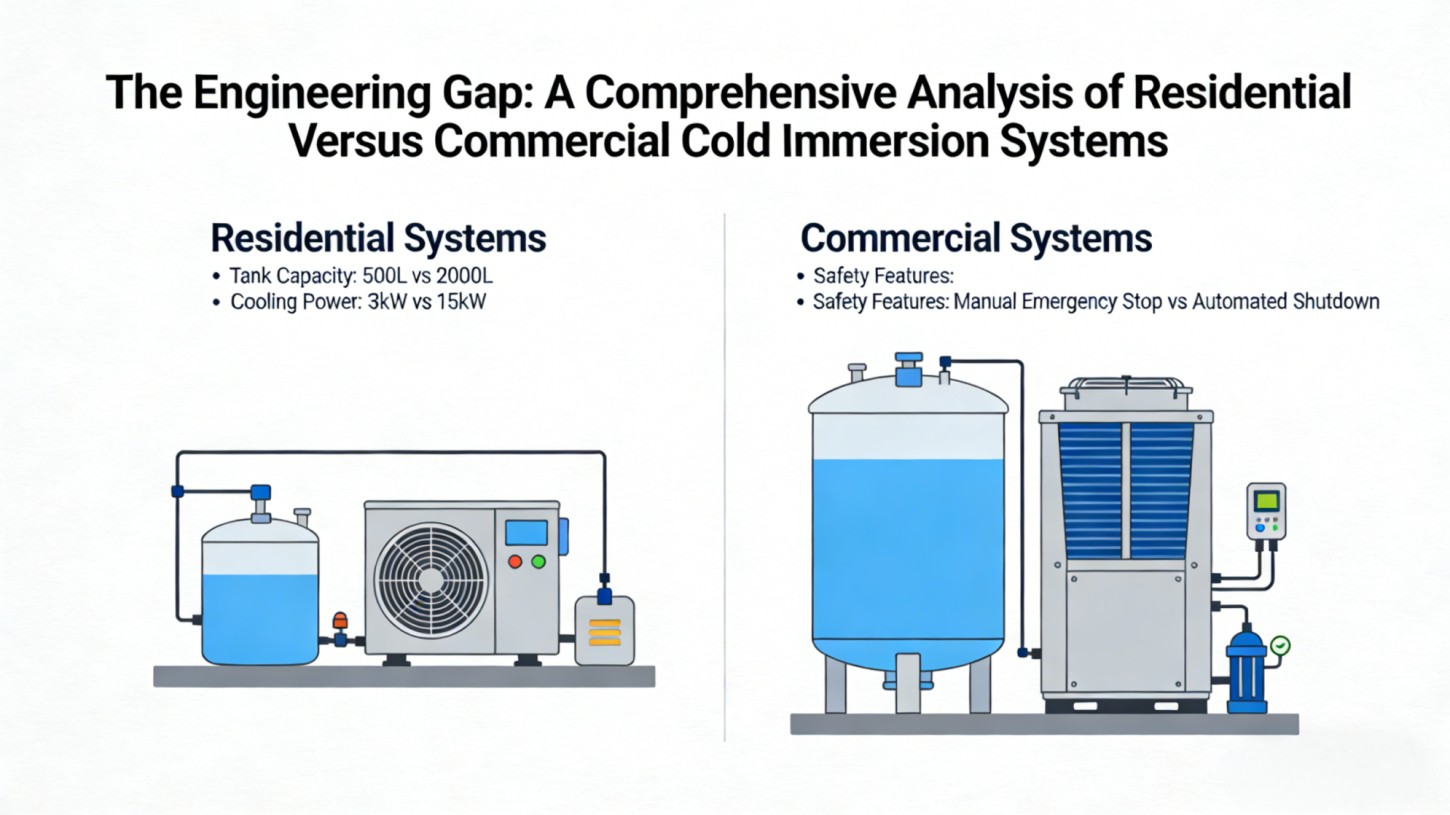
A residential cold plunge is engineered for a specific duty cycle: perhaps one or two users per day, with long intervals of dormancy that allow the chiller to recover temperature and the filtration system to slowly polish the water. In stark contrast, a successful commercial installation in a busy metropolitan health club may see upwards of 50 to 100 users daily.This exponential increase in load places catastrophic stress on components not designed for continuous operation.
Thermal Load and Chiller Fatigue
The thermodynamics of a commercial environment are unforgiving. Each human body entering a cold plunge acts as a significant heat source, transferring kilojoules of thermal energy into the water mass. In a residential setting, a 0.5 HP chiller might require two hours to pull the temperature back down after a use—a distinct non-issue for a single user. In a commercial setting, where users may rotate every 10 to 15 minutes, a residential-grade chiller simply cannot overcome the heat load. The result is a gradual creep in water temperature throughout the day, degrading the therapeutic value of the service and leading to customer complaints. To compensate, these undersized units run at 100% duty cycle, leading to rapid compressor burnout, capacitor failure, and shortened equipment lifecycles.
The Sanitation Crisis
Beyond thermal performance, the "pro-sumer" trap creates severe sanitation liabilities. Residential units often rely on simple cartridge filters and low-output ozone generators intended to manage the biological load of a single family. When subjected to the sweat, oils, skin cells, and cosmetic products of dozens of strangers, these systems are quickly overwhelmed. The lack of active surface skimming—a feature standard in commercial pools but rare in residential tubs—allows a biofilm of lipids to accumulate on the water's surface, creating a breeding ground for pathogens such as Pseudomonas aeruginosa and Legionella .The operational consequence is cloudy, unsafe water that necessitates frequent draining and refilling, driving up water and labor costs while simultaneously taking the revenue-generating asset offline.
The Rise of the Recovery Suite Ecosystem
The context of these failures is the evolving business model of the "Recovery Suite." Global data suggests that the inclusion of recovery zones in fitness facilities has grown by 15% year-on-year.These suites are no longer loss-leaders or simple amenities; they are profit centers. Gyms are increasingly unbundling these services or creating premium membership tiers that include unlimited access to cold therapy.
This shift monetizes uptime. In a membership model where users pay a premium for access, a broken machine is a broken contract. The tolerance for downtime, which might be acceptable in a home gym, evaporates in a commercial setting. Data from the fitness equipment sector indicates that "brochure performance"—relying on manufacturer claims without empirical verification—has historically led to multi-billion-dollar inefficiencies due to asset failure.For the ice bath distributor, this means that the reliability of the supply chain is the primary product; the hardware is merely the delivery mechanism for that reliability.


Part II: Supply Chain Architecture and Geopolitics
Global Imbalances and Import Dependency
The manufacturing landscape for wellness hardware in 2026 is characterized by profound geographic concentration. The United States and Europe remain the preeminent consumer markets for fitness and recovery equipment, driven by high disposable incomes and deeply ingrained wellness cultures. However, the production base for this equipment is overwhelmingly anchored in Asia, particularly China.
The Reality of Manufacturing Concentration
China's dominance in this sector is absolute in terms of volume. In the broader fitness equipment category, China produces approximately 3.8 million tons annually, dwarfing US production of 285,000 tons.This disparity creates a supply chain that is inherently elongated and vulnerable. For a distributor based in North America or Europe, the reliance on a single geographic source for critical components—chillers, acrylic shells, and control boards—introduces significant strategic risk.
This concentration is not merely about final assembly. The upstream supply chain for refrigeration components (compressors, heat exchangers) and raw materials (stainless steel, acrylic resins) is similarly clustered. A disruption in the industrial zones of Guangdong or Zhejiang, whether due to energy policy, labor shortages, or public health events, ripples instantly through the global availability of commercial ice baths.
Logistics Volatility: The "Red Sea" Effect
In 2026, the logistics of moving heavy, bulky wellness equipment are defined by volatility. Ocean freight remains the only economically viable mode of transport for ice baths, which are voluminous and heavy. Air freight, costing up to 12–15 times more than ocean transport, is reserved only for the most desperate of emergency spare parts shipments.
The stability of ocean freight routes, however, has been compromised. The prolonged instability in critical maritime corridors, such as the Red Sea, has acted as a "wild card" for global logistics.Diversions from the Suez Canal to the Cape of Good Hope add weeks to transit times and consume vast amounts of vessel capacity. This creates a cascade of disruptions:
Increased Transit Times: Shipments that once took 30 days now require 45 to 60 days.
Port Congestion: The erratic arrival of vessels leads to "bunching" at destination ports, overwhelming terminal capacity and delaying customs clearance.
Equipment Shortages: The extended time containers spend at sea creates a deficit of empty containers at origin ports in Asia, further choking export capabilities.
Paradoxically, this route volatility exists alongside structural overcapacity in the global fleet, leading carriers to utilize "blank sailings" (canceled voyages) to artificially support freight rates.For the distributor, this means that a booked shipment is not a guaranteed shipment. Cargo is frequently "rolled" to subsequent vessels, adding unpredictable delays to the supply chain.
Strategies for Resilience: Vertical Integration and Nearshoring
To mitigate these systemic risks, forward-thinking market participants are altering their supply chain architecture.
The Move Toward Vertical Integration
Leading manufacturers are pursuing deep vertical integration to insulate themselves from component volatility. Rather than acting as assemblers of off-the-shelf aquarium chillers and generic tubs, these manufacturers are bringing critical processes in-house.This includes the fabrication of heat exchangers, the molding of insulation, and the development of proprietary control firmware. For a distributor, partnering with a vertically integrated manufacturer offers a layer of security; these partners have greater control over their production schedules and quality output, reducing the risk of "force majeure" delays caused by sub-tier supplier failures.
Nearshoring and "China Plus One"
The concept of "decoupling" has evolved from political rhetoric to operational strategy. By 2026, significant investments are being made to establish alternative manufacturing ecosystems in regions like Mexico, Vietnam, and Eastern Europe.This "China Plus One" strategy allows distributors to diversify their risk. While high-tech refrigeration components may still originate in Asia, the bulky assembly and fabrication of tubs are increasingly moving closer to the end consumer. This nearshoring reduces transit times and allows for greater agility in responding to demand fluctuations.
Packaging and Crating Standards
The physical movement of commercial ice baths presents its own set of technical challenges. These units are heavy, fragile, and sensitive to environmental stressors.
ISPM-15 and Biosecurity
International trade relies on wood packaging—pallets and crates. However, strictly enforced biosecurity regulations, specifically ISPM-15 (International Standards for Phytosanitary Measures No. 15), govern the movement of wood across borders to prevent the spread of invasive pests.
Compliance: All wooden crates must be heat-treated (HT) to a core temperature of 56°C for 30 minutes or fumigated with Methyl Bromide (MB).
Risk: Non-compliant packaging—crates missing the IPPC stamp or showing signs of bark—can result in the rejection of the entire container at the port of entry.For a distributor, having a container of pre-sold units turned away at the port of Long Beach or Rotterdam is a financial and reputational disaster.
Alternative: Smart supply chains are increasingly utilizing engineered wood (plywood, OSB) or plastic pallets, which are exempt from ISPM-15 regulations, to eliminate this compliance risk entirely.
Environmental Protection
The ocean voyage exposes equipment to "container rain"—condensation cycles caused by temperature fluctuations that can saturate cargo. Commercial ice baths, with their sensitive electronics and compressors, must be vacuum-sealed in vapor barrier bags with desiccants to prevent corrosion of contacts and mold growth during transit.
Part III: Manufacturing Quality Assurance
From Detection to Prevention
In the high-stakes environment of commercial wellness, the traditional approach to quality—relying on incoming inspection at the distributor's warehouse—is obsolete. This model, known as Quality Control (QC), is merely a detection step; it identifies defects only after the time and capital to ship the product have already been spent.By 2026, the industry standard has shifted to Quality Assurance (QA) , a holistic discipline focused on validating the manufacturing process itself to prevent defects from ever occurring.
The Threat of "Quality Fade"
A pervasive risk in offshore manufacturing is "quality fade"—the gradual, often imperceptible degradation of product quality over the lifecycle of a supply relationship.A supplier, facing margin pressure, might substitute a 316L stainless steel liner with a cheaper 304 grade, or replace a high-quality pump seal with a generic alternative. These changes are rarely announced and are difficult to detect during a standard visual inspection. The impact, however, is delayed but severe: widespread field failures occurring 6 to 12 months after installation.
To combat quality fade, distributors must demand visibility into the "sub-tier" supply chain. It is not enough to know who assembles the ice bath; one must know who manufactures the compressor, the ozone generator, and the control board.
Process Validation and Factory Acceptance Testing (FAT)
Robust QA requires a shift from "policing parts" to "auditing processes." Distributors should require their manufacturing partners to implement Statistical Process Control (SPC) to monitor critical production variables.
Refrigerant Charge Accuracy: An overcharged or undercharged system will fail to cool efficiently and will shorten compressor life. Automated charging stations with data logging ensure every unit leaves the factory with the precise mass of refrigerant required.
Leak Testing: Every commercial unit must undergo rigorous pressure testing. The plumbing system should be pressurized to 1.5x its operating pressure and monitored for pressure decay over time to identify micro-leaks that water testing might miss.
Electrical Safety Testing: "Hi-pot" (High Potential) testing is non-negotiable for wet appliances. This test applies high voltage to the electrical circuit to ensure the insulation is sufficient to protect the user from shock.
The Factory Acceptance Test (FAT) Protocol
For large commercial orders, a formalized FAT protocol should be executed before the goods leave the factory floor. This involves run-testing the units under load—not just turning them on, but requiring them to pull down a specific volume of water from 20°C to 3°C within a specified time window.Acoustic testing should also be conducted to ensure the chiller noise levels are within the acceptable decibel range for a spa environment.
Part IV: The Regulatory Firewall
Electrical Safety and UL 1563
The era of the "wild west" in cold plunge regulation is effectively over. As of January 2025, the regulatory landscape shifted dramatically with the expansion of the UL 1563 standard. Previously, UL 1563 covered "Electric Spas, Equipment Assemblies, and Associated Equipment," focusing primarily on hot tubs. The updated scope now explicitly covers electrically powered cold tubs and ice baths , as well as combination hot/cold units.
This development is a watershed moment for the industry. It removes the ambiguity that allowed manufacturers to import non-certified units or units listed under irrelevant standards (like aquarium chillers).
The Mark of Safety: Regulatory bodies and electrical inspectors (Authorities Having Jurisdiction or AHJs) will now specifically look for the UL 1563 listing on cold plunge equipment. Units without this mark are subject to "red-tagging"—being shut down by inspectors—posing an existential risk to the facility operator.
Testing Rigor: The standard addresses the specific risks of cold water immersion, including the performance of the cooling function, the safety of heat pumps, and specific marking/instruction requirements regarding hypothermia and entrapment risks.
The NRTL Process for Importers
For distributors importing into the United States, compliance is enforced by OSHA's Nationally Recognized Testing Laboratory (NRTL) program. Marks from UL, Intertek (ETL), and TUV are legally equivalent, provided the testing is done to the correct ANSI/UL standard.
Field Evaluation vs. Listing: Distributors must beware of the distinction between a "Field Evaluation" and a full "Listing." A Listing applies to the product model produced in the factory. A Field Evaluation is a one-time, on-site inspection of a specific unit by an engineer—a process that is prohibitively expensive and disruptive if required for every installation.Ensuring the manufacturing partner has completed the full listing process is critical for scalable distribution.
European Compliance (CE and UKCA)
For the European market, the CE mark acts as the passport for the product. This requires compliance with the Low Voltage Directive, the Electromagnetic Compatibility (EMC) Directive, and increasingly, the Ecodesign Directive for energy efficiency.
Documentation: Manufacturers must maintain a "Technical Construction File" (TCF) for 10 years, detailing the risk assessments, circuit diagrams, and test reports that justify the CE mark.
UKCA: Following Brexit, Great Britain requires the UKCA mark, which largely mirrors CE requirements but requires separate administrative processes.
Part V: Sanitation and Public Health Standards
The Chemistry of Clean
Commercial cold plunges present a unique challenge to water quality. Unlike a hot tub, where heat helps to kill some bacteria (though it promotes others), cold water preserves pathogens. Furthermore, the immense "bather load" in a commercial gym introduces significant organic contaminants—sweat, skin cells, hair, lotions, and deodorants.
NSF/ANSI 50 and Materials Safety
The benchmark for commercial recreational water safety in North America is NSF/ANSI 50 . This standard evaluates materials and components for pools, spas, and hot tubs.
Toxicology: NSF 50 ensures that the materials in contact with the water (the acrylic shell, the PVC piping) do not leach harmful toxins.
Filtration Performance: The standard validates that the filter removes particles as claimed. Commercial codes typically require a "turnover rate"—the time it takes to filter the entire volume of water—of 15 to 30 minutes for high-risk, small-volume vessels like ice baths.
Managing the Biofilm Risk
A critical missing feature in many "pro-sumer" tubs is surface skimming. Roughly 60% of pollutants in a plunge tub (oils, hair) float on the surface. If not removed, they form a "scum line" that harbors biofilm—a protective layer that shields bacteria like Pseudomonas from disinfectants.
Commercial Requirement: Most health codes (eg, the Model Aquatic Health Code) require a perimeter overflow or a skimmer weir to continuously remove this surface layer. Distributors must ensure their commercial offerings feature active skimming, not just bottom drains.
Disinfection Strategies
While marketing often highlights UV-C lights and Ozone generators, these are classified as "secondary" or "supplemental" sanitizers. They kill bacteria passing through the plumbing but provide no protection in the tub itself.
The Residual Requirement: Commercial codes almost universally require a measurable "residual" sanitizer in the water, such as chlorine or bromine, to kill pathogens introduced by new bathers immediately.
Material Compatibility: This requirement dictates material choices. The heat exchanger in the chiller must be titanium or cupronickel to withstand the corrosive nature of chlorinated or brominated water. Standard stainless steel or copper exchangers will corrode, leading to catastrophic refrigerant leaks.
Part VI: Accessibility and Inclusive Design
ADA Compliance in the Recovery Room
As cold plunge therapy becomes a standard offering, it falls under the purview of accessibility laws, most notably the Americans with Disabilities Act (ADA) in the US. The Department of Justice's 2010 Standards for Accessible Design explicitly cover "spas," a category that includes cold plunges.
Structural Requirements
Designing for inclusivity is not just a legal obligation; it expands the addressable market to adaptive athletes and users with limited mobility.
Transfer Systems: Commercial units typically require a transfer wall or platform. This surface must be 16 to 19 inches high, at least 24 inches wide, and allow a user to transfer laterally from a wheelchair.
Clear Floor Space: The installation site must provide a 30-inch by 48-inch clear floor space adjacent to the transfer point to accommodate a wheelchair's approach.
Lifts: In some jurisdictions, or for tubs with walls higher than standard transfer heights, a pool lift may be required. This lift must be independently operable by the user.
The Operational Challenge
Retrofitting a non-compliant installation is incredibly costly. Distributors must educate their facility partners during the design phase. While some operators may attempt to argue that providing "alternative accommodations" (like cryotherapy) exempts them from making the plunge accessible, this is a legally perilous strategy that invites discrimination lawsuits.The prudent path is to source equipment designed with ADA-compliant transfer lips and to layout the facility with adequate turning radii from day one.
Part VII: The Digital Nervous System
IoT, APIs, and the Smart Facility
In 2026, a commercial ice bath is not just a tub of water; it is a connected device within a "Smart Gym" ecosystem. The integration of Internet of Things (IoT) technology is a primary driver of market value, transforming maintenance from a reactive hassle into a proactive science.
Remote Monitoring and Control
Commercial operators manage complex facilities with minimal staff. They cannot afford to have an employee manually checking the temperature of the ice bath every hour.
Cloud Connectivity: Modern commercial chillers must offer WiFi or cellular connectivity, allowing facility managers to monitor water temperature, flow rates, and sanitation status from a centralized dashboard.
Alerts: If a chiller fails overnight or if the water temperature drifts outside the set range, the system should push an alert to the maintenance team's mobile devices, allowing for resolution before the gym opens to members.
API Integration and Member Experience
The digital layer also enhances the user experience. Through API integration with gym management software (like Zipper or dedicated studio apps), the ice bath becomes part of the member's digital journey.
Booking: Members can reserve plunge sessions via the gym's app.
Personalization: Integration with wearables (eg, Apple Watch, WHOOP) allows the user to log their recovery metrics automatically. In advanced setups, the tub can even recognize the user via RFID and adjust lighting or settings to their profile.
Predictive Maintenance
The ultimate value of IoT lies in predictive maintenance. By analyzing the current draw of the compressor or the vibration signature of the pump, AI algorithms can predict component failure before it happens.This allows distributors to dispatch a technician with the correct part to fix a degrading pump seal before it leaks, maximizing uptime and preserving the facility's revenue stream.
Part VIII: Economic Models and TCO
Moving Beyond "First Cost"
A common pitfall in B2B procurement is the fixation on "First Cost"—the initial invoice price of the equipment. In the ice bath market, this is a dangerous metric. A residential unit might cost $5,000, while a robust commercial unit costs $15,000. However, the commercial reality is defined by Total Cost of Ownership (TCO).
The TCO Equation
Distributors must articulate the TCO value proposition to their partners.
Energy Efficiency: A well-insulated commercial tub with a high-efficiency variable-speed chiller can save thousands of dollars in electricity over a 5-year period compared to a poorly insulated tub running a single-speed compressor at 100% capacity.
Downtime Cost: The cost of the machine is negligible compared to the cost of lost revenue. If a plunge generates $20 per session and runs 30 sessions a day, it generates $600 daily. A two-week outage waiting for a replacement residential chiller costs the facility $8,400 in lost revenue—more than the price difference between the cheap and premium units.
Labor: Automated chemical dosing and self-cleaning filtration systems reduce the staff hours required to maintain the unit. In a labor-constrained market, saving 30 minutes of staff time daily is a significant operational advantage.
Warranty and Service Level Agreements (SLAs)
The warranty is the financial instrument that backs the reliability promise. In B2B, standard consumer warranties often do not apply.
Commercial Exclusions: Distributors must ensure the warranty explicitly covers commercial use . Many residential warranties are voided the moment the unit is installed in a gym.
Labor Coverage: A "parts-only" warranty is insufficient for a commercial operator who lacks the technical skills to replace a compressor. Premium SLAs include "white glove" labor coverage, guaranteeing on-site repair within a set window (eg, 48 hours).
Spare Parts Inventory: To support these SLAs, distributors must hold local inventory of critical spares. Relying on shipping a replacement pump from China when a machine goes down is not a viable service model.
Part IX: Strategic Framework for 2026
A Blueprint for Market Leadership
The commercial ice bath market of 2026 rewards those who prioritize infrastructure over aesthetics. For distributors and partners, the following strategic framework provides a path to sustainable growth.
1. The "Resilient Supplier" Audit
Distributors must rigorously vet their manufacturing partners. Do not accept generic certificates. Demand to see the UL 1563 listing number and verify it in the UL directory. Audit the supplier's QA processes , not just their finished goods. Look for vertical integration that secures the supply of critical components.
2. The Logistics Buffer
Abandon "Just-in-Time" inventory models for Asian imports. The volatility of ocean freight demands a "Just-in-Case" strategy. Maintain a domestic buffer stock of 4 to 6 weeks' worth of critical SKUs to absorb the shocks of Red Sea diversions and port strikes.
3. The Compliance-First Sales Motion
Educate the facility operator. Position compliance (ADA, NSF, UL) not as a burden but as risk management. Use TCO calculators to demonstrate that a higher upfront investment in compliant, energy-efficient equipment yields a higher ROI over the asset's lifecycle.
4. The Service-Led Ecosystem
Transition from selling hardware to selling "uptime." Bundle the equipment with a service contract that includes preventative maintenance, regular filter changes, and remote monitoring. Use IoT data to prove the value of the service, showing the customer exactly how many hours of downtime were avoided through proactive care.
Conclusion
The commercialization of cold water immersion is a permanent shift in the landscape of global wellness. By 2026, the ice bath will be as ubiquitous in gyms as the treadmill, and it will be judged by the same standards: durability, safety, and operational efficiency.
The winners in this evolving market will not be the brands with the flashiest social media presence, but the distributors and partners who build the most reliable supply chains. They will be the ones who understand that a broken chiller is a broken business model. They will be the ones who navigate the complex web of regulations to protect their clients from liability. And they will be the ones who recognize that in the high-performance world of commercial wellness, reliability is the ultimate luxury.

Appendix: Data Tables and Reference Guides
Table 1: Commercial vs. Residential/Pro-sumer Equipment Comparison
Feature | Residential / Pro-sumer | Commercial Grade (2026 Standard) | Operational Impact |
Cooling Capacity | 0.25 HP - 0.5 HP | 0.8 HP - 1.5 HP | Ability to maintain <5°C temp under high bather load (50+ users/day). |
Filtration | Cartridge only | Cartridge + Ozone + Surface Skimmer | Removal of biofilm precursors (oils/hair); compliance with health codes. |
Sanitization | UV or Ozone only | Chemical Feeder (Chlorine/Bromine) | Residual kill of pathogens; prevents person-to-person transmission. |
Certification | None or CE only | UL 1563, NSF 50, ETL | Prevents "red-tagging" by inspectors; ensures insurance coverage. |
Connectivity | Bluetooth (local) | WiFi / Cellular / API | Remote monitoring; integration with facility management software. |
Warranty | 1 Year (Parts), Void in Gyms | 3-5 Years (Shell), 1-2 Years (Labor) | Lowers TCO; guarantees uptime via SLAs. |
Table 2: 2026 Supply Chain Risk Matrix & Mitigation
Risk Vector | Specific Threat | Impact Probability | Mitigation Strategy |
Logistics | Red Sea/Suez Canal Disruptions | High | "China+1" Sourcing: Diversify manufacturing to Vietnam/Mexico. Buffer Stock: Increase domestic inventory by 30%. |
Regulatory | UL 1563 Enforcement | Very High | Strict Vetting: Only source units with verified UL listings for "Cold Tubs." Field evaluations for legacy units. |
Manufacturing | "Quality Fade" (Material Substitution) | Medium | Process Audits: Implement SPC monitoring. Sub-tier Visibility: Audit component suppliers (compressors/pumps). |
Biosecurity | ISPM-15 Non-Compliance | Low (but Catastrophic) | Alternative Packaging: Use plastic or plywood pallets/crates to bypass wood restrictions entirely. |
Table 3: Total Cost of Ownership (TCO) Model (5-Year Horizon)
Cost Category | Residential Unit ($5,000) | Commercial Unit ($15,000) | Notes |
Initial Purchase | $5,000 | $15,000 | The "First Cost" trap. |
Maintenance Labor | $18,250 ($10/day x 5 yrs) | $5,475 ($3/day x 5 yrs) | Commercial units have auto-dosing/cleaning; residential requires manual care. |
Energy Cost | $6,000 (Inefficient cooling) | $3,500 (High-efficiency) | Better insulation and variable speed compressors reduce OpEx. |
Revenue Loss (Downtime) | $15,000 (est. 15 days/yr) | $2,000 (est. 2 days/yr) | Commercial durability and SLAs minimize revenue leakage. |
Replacement Cost | $5,000 (Replace in Year 3) | $0 (10+ year lifespan) | Residential units fail early under commercial load. |
TOTAL 5-YEAR COST | $49,250 | $25,975 | Result: Commercial unit saves ~$23,000 despite higher sticker price. |
At Quanguan, we work directly with gyms,recovery studios, and professional facilitiesto ensure commercial ice bath systems areinstalled correctly from day one. With hands-on manufacturing experience and adeep understanding of real-worldinstallation challenges, our team helpsclients avoid common mistakes, reducelong-term operating costs, and achievestable, reliable performance.
lf you are planning a commercial ice bath installation or evaluating systemrequirements for your facility, contact Quanguan to discuss your project and getpractical guidance tailored to your spaceand usage needs.