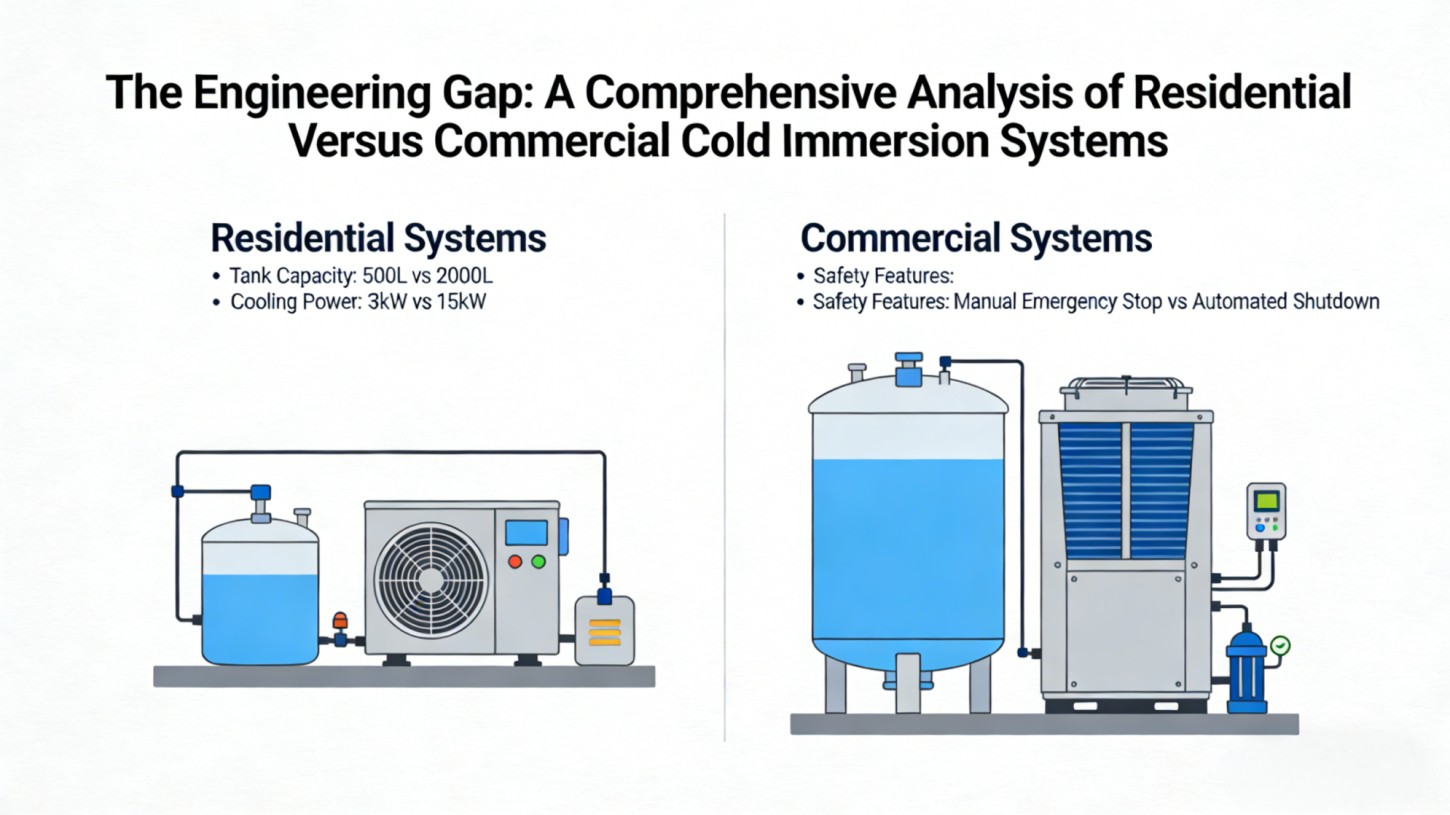

1. Introduction: The Renaissance of Cold Therapy and the Infrastructure Crisis
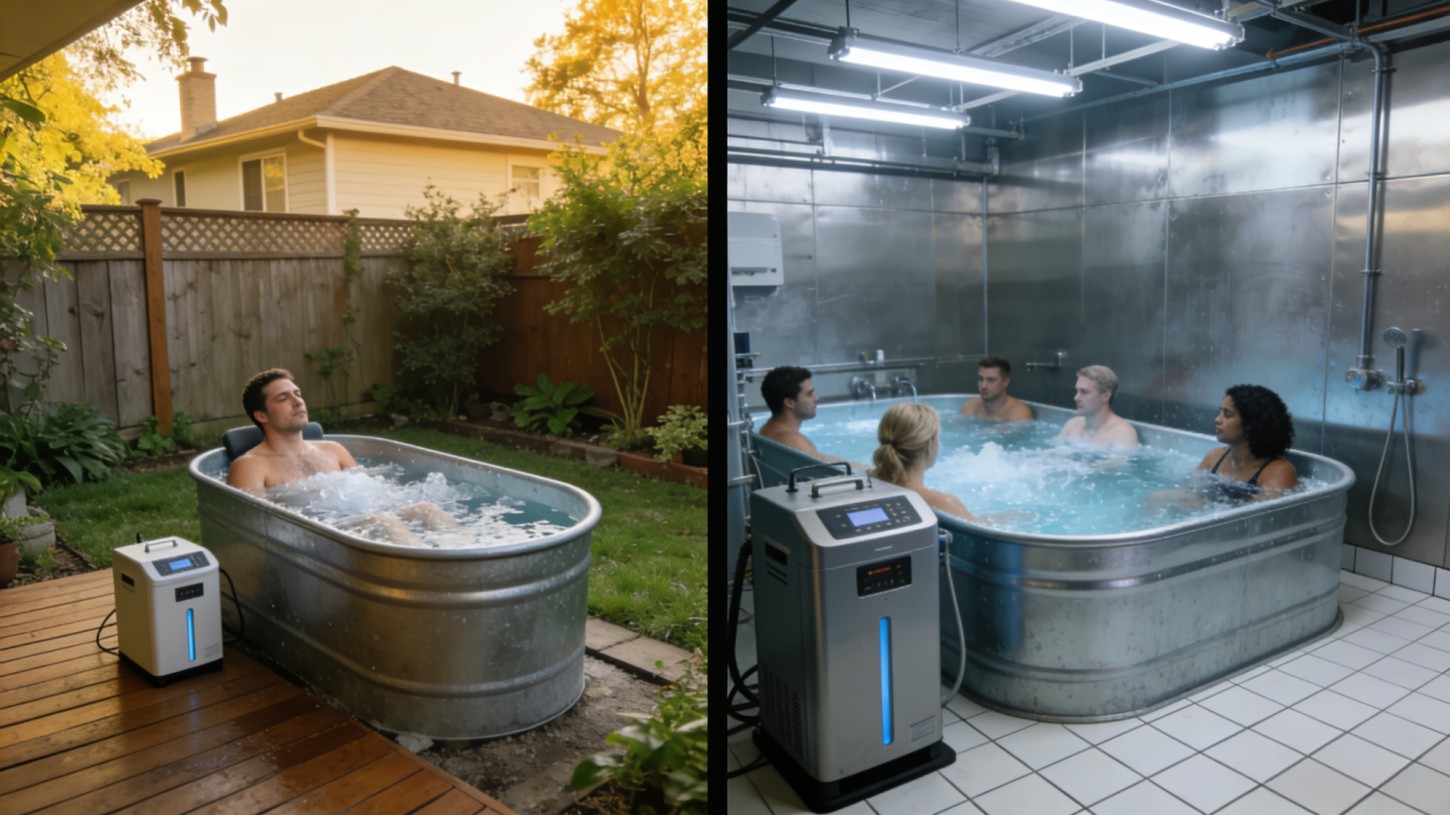
The contemporary wellness landscape has witnessed a paradigm shift, characterized by the mass adoption of contrast therapy and Cold Water Immersion (CWI). No longer the exclusive domain of elite athletic training complexes or clinical rehabilitation centers, cold plunge therapy has permeated the mainstream fitness consciousness. From boutique recovery studios and high-end health clubs to residential garages, the demand for consistent, therapeutic cold exposure is at an all-time high.This democratization of recovery modalities offers profound benefits for metabolic health, inflammation reduction, and mental resilience. However, this rapid expansion has precipitated a quiet but significant infrastructure crisis within the commercial sector.
As fitness professionals, gym owners, and recovery studio founders race to integrate cold therapy into their service offerings, a critical confusion has emerged regarding equipment specification. The market is saturated with products that appear aesthetically similar—sleek tubs, compact chillers, and digital displays—yet possess vastly different engineering DNA. The distinction between a residential "home use" unit and a true commercial-grade system is not merely a matter of price point or branding; it is a fundamental divergence in thermodynamic capacity, microbiological safety, mechanical durability, and regulatory compliance.
The deployment of residential-grade equipment within high-traffic commercial environments has led to a pattern of operational failures. These range from the inconvenience of thermal instability—where the water temperature rises uncontrollably during peak hours—to catastrophic biological hazards involving biofilm proliferation and pathogen transmission.Furthermore, the hidden risks of electrical non-compliance and structural damage due to condensation present liability exposures that many business owners fail to anticipate until it is too late.
This report provides an exhaustive technical analysis of the structural, mechanical, and operational disparities between home-use ice bath systems and commercial-grade solutions. By dissecting the underlying engineering principles—spanning thermodynamics, fluid dynamics, microbiology, and materials science—we aim to clarify why residential units frequently fail under the rigors of commercial application. The objective is to equip stakeholders with the nuanced understanding necessary to make informed infrastructure investments, ensuring safety, efficacy, and long-term operational viability in a sector where equipment failure directly impacts human health and business reputation.
1.1 The Evolution of the Cold Plunge Market
Historically, CWI was a logistical challenge managed through crude methods: dumping bags of consumable ice into bathtubs, livestock troughs, or repurposed chest freezers. While effective for sporadic, individual use, this "analog" approach is operationally unsustainable for businesses due to the recurring cost of ice and the inability to maintain consistent temperatures. The modernization of the industry introduced the "active" cold plunge—integrated systems combining a vessel, a circulation pump, a filtration loop, and a mechanical water chiller.
As the market matured, product development bifurcated. One trajectory focused on the residential consumer: minimizing footprint, reducing noise for indoor use, and prioritizing aesthetic integration into the home. These systems are engineered for low duty cycles, typically handling one or two users per day. The second trajectory focused on commercial utility: maximizing heat rejection rates, ensuring rapid water turnover for sanitation, and hardening components against continuous 24/7 operation.
The friction point in the current industry landscape arises where these two paths intersect. Often, equipment designed for the low-impact residential sector is rebranded or misconceived as suitable for commercial use. This report systematically dismantles these misconceptions, analyzing the specific failure points that emerge when residential engineering meets commercial demand.
2. Performance Problems: The Thermodynamics of Heat Rejection
The primary function of any cold plunge system is not merely to hold cold water, but to reject heat. In a thermodynamic context, an ice bath is a dynamic system constantly battling heat gain from two primary vectors: the ambient environment (conduction and convection through the tub walls and surface) and the metabolic and physical heat load introduced by the user.The most prevalent failure in deploying residential units for commercial tasks is a fundamental misunderstanding of cooling capacity versus cooling load.
2.1 The Myth of Horsepower and the Reality of BTU
In the consumer market, chillers are frequently marketed and sold based on Horsepower (HP) ratings—typically ranging from 1/4 HP to 1/2 HP for standard home units. However, in the realm of thermal engineering, HP is often a misleading metric for cooling performance. It refers to the power of the compressor motor—the electrical input—rather than the actual heat removal capacity of the system. The definitive metric for performance is the British Thermal Unit per hour (BTU/hr), which quantifies the amount of heat energy the system can actively transfer from the water to the air in one hour.
Residential chillers, often rated at 1/4 HP or 1/3 HP, typically deliver a cooling capacity between 2,000 and 3,000 BTU/hr. While this capacity is sufficient for maintaining temperature in a small, well-insulated tub used once per day by a single individual, it is woefully inadequate for the dynamic heat loads of a commercial setting. In contrast, commercial systems usually start at 1 HP, delivering upwards of 9,000 to 12,000 BTU/hr, with larger industrial units utilized in spas exceeding 24,000 BTU/hr.
Understanding this disparity requires examining the specific heat of water. Water has a specific heat capacity of approximately 1 BTU per pound per degree Fahrenheit ($1 text{ BTU/lb}cdot^circtext{F}$). This means that to cool 100 gallons of water (which weighs approximately 833 lbs) by just $1^circtext{F}$, the system must remove 833 BTUs of heat energy.
Q = m* c * △T
Where:
● Q = Heat energy (BTU)
● m = Mass of water (lbs)
● c = Specific heat capacity (1 BTU/lb circtextF)
● △T = Temperature change (circtextF)
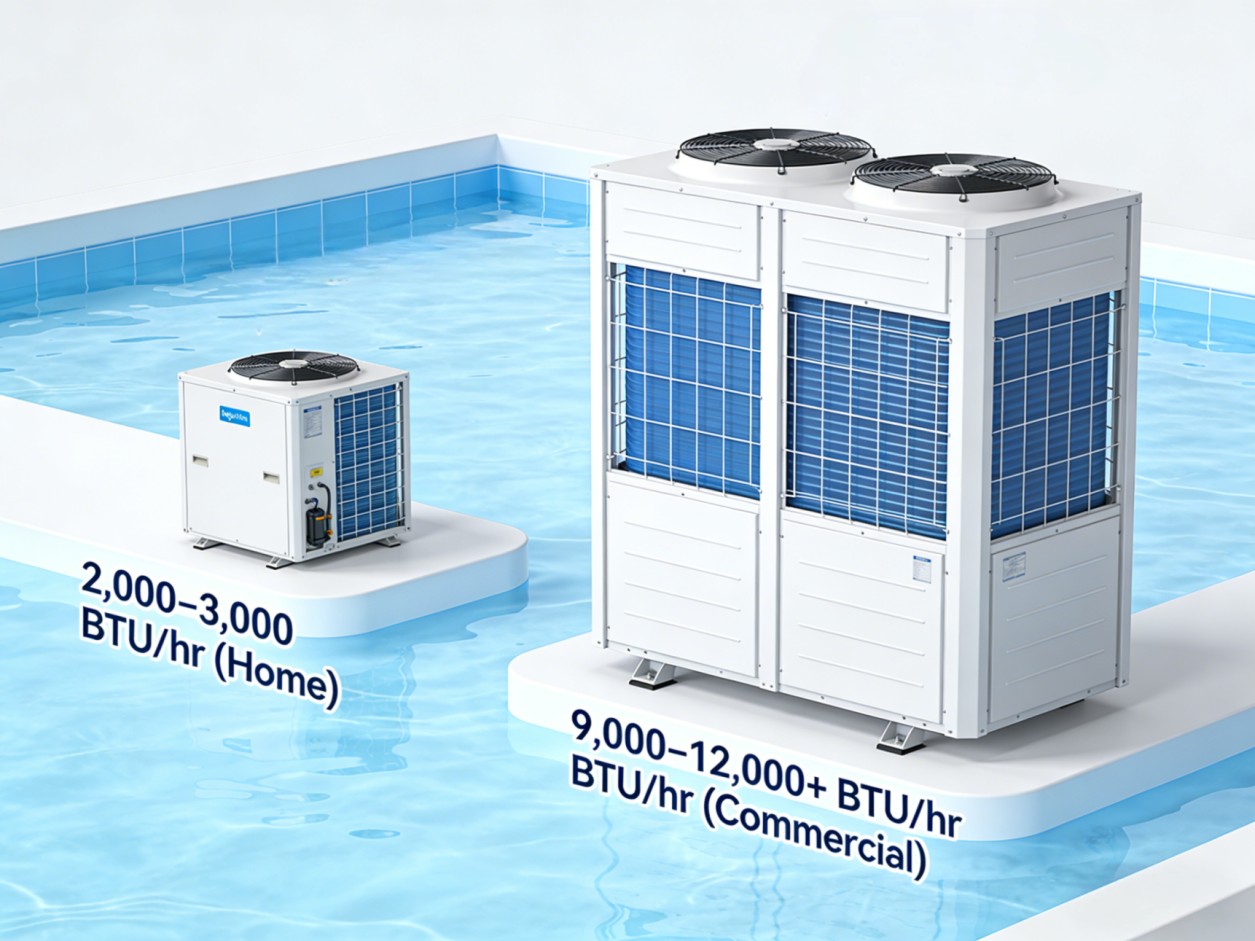
A residential chiller with a 3,000 BTU/hr capacity can effectively remove heat, but the rate at which it does so is the limiting factor. If a commercial scenario requires a $5^circtext{F}$ drop in temperature for 100 gallons of water, the energy required is $833 text{ lbs} times 5 = 4,165 text{ BTUs}$. A 3,000 BTU/hr chiller would take nearly 1.5 hours to achieve this, assuming zero additional heat gain from the environment—an ideal scenario that never exists in reality. A 12,000 BTU/hr commercial chiller would accomplish the same task in approximately 20 minutes.
2.2 The Physics of Recovery Time and "Thermal Runaway"
The critical performance differentiator for gym owners is "recovery time"—the duration required for the water to return to the target setpoint (e.g., $45^circtext{F}$ or $7^circtext{C}$) after a user exits. When a human body enters an ice bath, it acts as a significant heat source. The body constantly generates metabolic heat, approximately 105 watts ($~356 text{ BTU/hr}$) at rest, but potentially higher immediately post-exercise. More significantly, the body itself is a thermal mass at $approx 98.6^circtext{F}$ ($37^circtext{C}$) entering a medium that is $50^circtext{F}$ ($28^circtext{C}$) colder.
Heat transfer occurs rapidly via conduction and convection across the skin surface area (approx. $1.8 m^2$ for an average adult).This creates a "thermal shock" to the water. In a residential scenario, a single user might raise the water temperature of a small tub by $2^circtext{F}$ to $4^circtext{F}$. A 0.3 HP residential chiller might take 45 to 60 minutes to recover that temperature deficit.This is acceptable for a home user plunging once in the morning; the unit has the remainder of the day to recover.
However, in a commercial gym where users expect to plunge back-to-back every 10 to 15 minutes, a residential unit cannot physically keep pace with the heat input. The result is "thermal runaway."
● User 1 (08:00 AM): Enters at $45^circtext{F}$. Exits. Temp rises to $47^circtext{F}$.
● Chiller: begins cooling, but only drops temp to $46.5^circtext{F}$ before User 2 arrives.
● User 2 (08:15 AM): Enters at $46.5^circtext{F}$. Exits. Temp rises to $48.5^circtext{F}$.
● User 3 (08:30 AM): Enters at $48^circtext{F}$.
By the afternoon, the water temperature may drift into the mid-50s or 60s, rendering the therapy ineffective and leading to customer complaints that "the ice bath isn't cold".Commercial systems utilizing high-BTU chillers are designed to match or exceed the rate of heat introduction, actively cooling during the session and recovering the setpoint in mere minutes between users.
2.3 Environmental Factors: Ambient Stress and Condenser Efficiency
The performance of air-cooled chillers is heavily dependent on the ambient air temperature. Residential chillers are typically designed with smaller condensers and fans, optimized for quieter, indoor, climate-controlled environments (typically $70^circtext{F}$/$21^circtext{C}$). The efficiency of the refrigeration cycle is dictated by the temperature differential between the refrigerant and the ambient air.
When residential units are placed in commercial gym environments—which are often non-climate-controlled warehouses, garages, or outdoor patios—they face what is technically termed "Excessive Heat Load".17 As the ambient air temperature rises, the chiller's ability to reject heat diminishes.
If a residential chiller is operating in a $90^circtext{F}$ ($32^circtext{C}$) environment, the head pressure in the compressor rises significantly. This reduces the cooling capacity (BTU/hr) just as the heat load on the tub (from the hot air) is increasing. This "double penalty" often causes residential units to trip their high-pressure safety cutouts or trigger "High Temperature" alarms, shutting down exactly when they are needed most.17
Commercial units mitigate this through "oversizing." They feature larger condenser surface areas and industrial-grade high-static pressure fans designed to maintain heat rejection efficiency even in high ambient temperatures (often rated for up to $110^circtext{F}$ or $43^circtext{C}$).They are engineered to operate in the hostile environments of CrossFit boxes and outdoor spas where residential units would suffocate.
2.4 The Compressor Duty Cycle Limitation
A subtle but fatal flaw in utilizing home units for business applications involves the compressor's designed duty cycle. Residential refrigeration compressors (often reciprocating types) are designed for intermittent operation—running until the setpoint is reached and then resting (cycling off). This rest period allows the oil to return to the compressor and the motor windings to cool.
In a high-demand commercial setting, the continuous heat load forces the compressor to run continuously (100% duty cycle). Residential compressors are generally not rated for continuous 24/7 operation at maximum load. This leads to overheating of the compressor windings, lubrication breakdown, and premature mechanical failure—often seizing within months of installation.Commercial chillers utilize industrial scroll or rotary compressors specifically rated for continuous duty. Scroll compressors, in particular, have fewer moving parts and can tolerate liquid slugging better than reciprocating models, ensuring longevity under relentless workloads.
3. Maintenance and Hygiene: The Microbiology of Cold Water
Perhaps the most critical, yet frequently overlooked, distinction between residential and commercial systems lies in water quality management. There is a dangerous and pervasive misconception in the "DIY" and home-user community that "cold water kills bacteria" or that the low temperature inhibits growth sufficiently to ignore rigorous sanitation.In reality, many pathogens are psychrophilic (cold-loving) or psychrotrophic (cold-tolerant). Pseudomonas aeruginosa (responsible for "hot tub rash" or folliculitis), E. coli, and even Legionella can survive and persist in cold water, merely reproducing at a slower rate than in warm water. In a commercial environment, where the bioload is high, the risk of cross-contamination is acute.
3.1 Filtration Surface Area and Fluid Dynamics
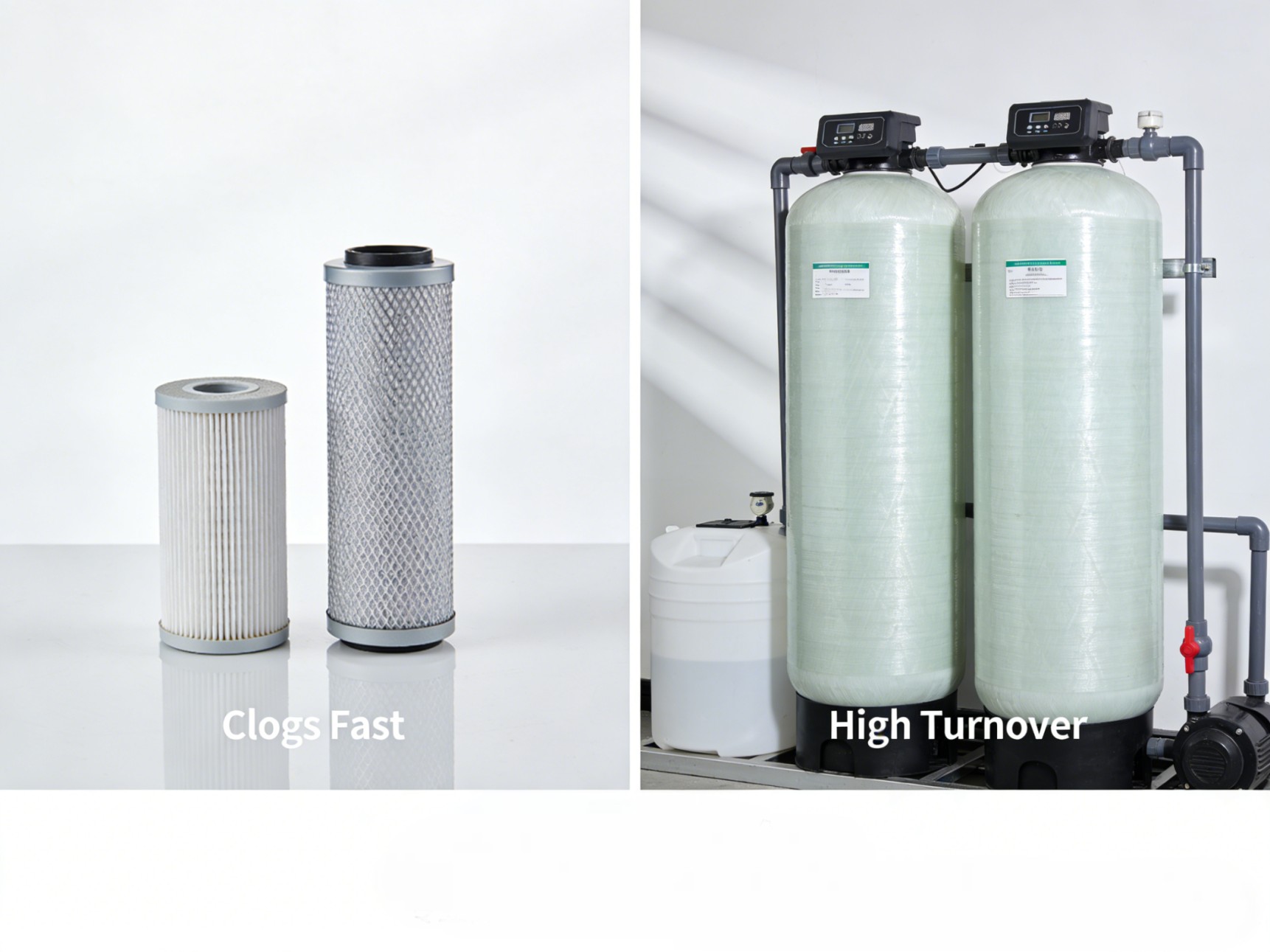
Effective water quality begins with physical filtration—the removal of particulate matter (skin cells, hair, clothing fibers, oils) that serves as food for bacteria. Residential cold plunges typically utilize small cartridge filters, often 10 inches by 2.5 inches, or simple paper pleat filters similar to those found in small inflatable pools.These filters have limited surface area, often ranging from 10 to 20 square feet.
In a residential setting with one user, the debris load is manageable. However, in a commercial environment with 50+ uses per day, the debris load is exponential. Each user introduces millions of dead skin cells, body oils, sweat, cosmetics, and lotions. A small residential filter will become saturated and "blinded" (clogged) within days, if not hours.
From a fluid dynamics perspective, a clogged filter drastically increases the pressure head in the plumbing system. As flow is restricted, the water moves too slowly through the chiller's heat exchanger. This low flow triggers safety sensors (flow switches) to shut down the chiller to prevent the heat exchanger from freezing solid—a common failure mode known as "short cycling" or "low flow alarm".
Commercial Distinctions:
● Filtration Area: Commercial units typically employ 50 sq. ft. to 100 sq. ft. reusable spa filters or large sand/glass media filters. This vast surface area allows the filter to hold significantly more particulate matter without restricting flow, extending the interval between cleanings.
● Turnover Rate: The "turnover rate" is the time it takes for the pump to filter the entire volume of water in the tub. Commercial pumps are sized to turn over the water 3 to 4 times per hour.A residential unit might filter the water once every 2 to 4 hours. In a gym, slow turnover means that User B enters the water while User A’s sweat and debris are still suspended in the solution. Rapid turnover ensures that contaminants are sequestered in the filter immediately.
● Active Skimming: Floating debris (oils, hair) creates a scum line that harbors bacteria. Commercial designs often include surface skimmers or weirs to remove floating debris immediately. Residential tubs often lack active skimming, allowing biofilm precursors to accumulate on the water surface and adhere to the bather.
3.2 The Biofilm Menace and Sanitation Technology
Biofilm is a slimy, protective matrix secreted by bacteria that adheres to piping, tub walls, and heat exchangers. It is an evolutionary defense mechanism that protects the colony from chemical sanitizers. Once established, biofilm is extremely difficult to remove without harsh scrubbing or enzymatic cleaners.Residential units with low flow rates and "dead zones" (areas of poor circulation) are breeding grounds for biofilm.
Sanitization Technologies:
● Ozone (O3) and UV-C: Advanced home units often feature small ozone generators or UV lights. While effective in theory, their efficacy is dependent on contact time and water clarity (turbidity). If the water is cloudy (due to body oils and insufficient filtration), UV light cannot penetrate to kill pathogens. Furthermore, residential ozone generators usually have low output (mg/hr), sufficient for a clean home tub but overwhelmed by the organic load of a gym.
● Chemical Compatibility: Commercial facilities must often adhere to local health department codes, which usually mandate a residual sanitizer like Chlorine or Bromine (maintaining 1–3 ppm). However, many residential units utilize heat exchangers made of standard stainless steel or aluminum, or seals that are not chemically resistant. Exposure to harsh oxidizers like chlorine can cause rapid corrosion and leaks in these units.
● Commercial Solutions: True commercial systems utilize chemical-resistant heat exchangers (e.g., Titanium or Cupronickel) and typically incorporate automated dosing systems. These systems use sensors to measure pH and ORP (Oxidation Reduction Potential) in real-time, automatically injecting sanitizer to match the bather load. This eliminates the human error inherent in manual dosing, ensuring the water is safe for every user.
3.3 Water Change Frequency and Operational Logistics
The operational cost of water changes—both in terms of water utility bills and labor—is a significant factor for businesses. A residential unit without advanced filtration might require water changes every 1–2 weeks with daily use. In a commercial gym, that same unit might require daily water changes to remain visually and biologically acceptable. This downtime (draining, cleaning, refilling, chilling) represents lost revenue.
Commercial systems with commercial-grade filtration and automated sanitation can extend water life to 4–6 weeks even under heavy load.24 This efficiency offers a measurable Return on Investment (ROI) by reducing maintenance labor and maximizing unit availability.
4. Noise and Durability: The Acoustics of Recovery
The acoustic profile of a cold plunge system is a major consideration, particularly for luxury recovery studios and home spas where a serene, meditative environment is part of the service.
4.1 Acoustic Footprint (Decibel Levels)
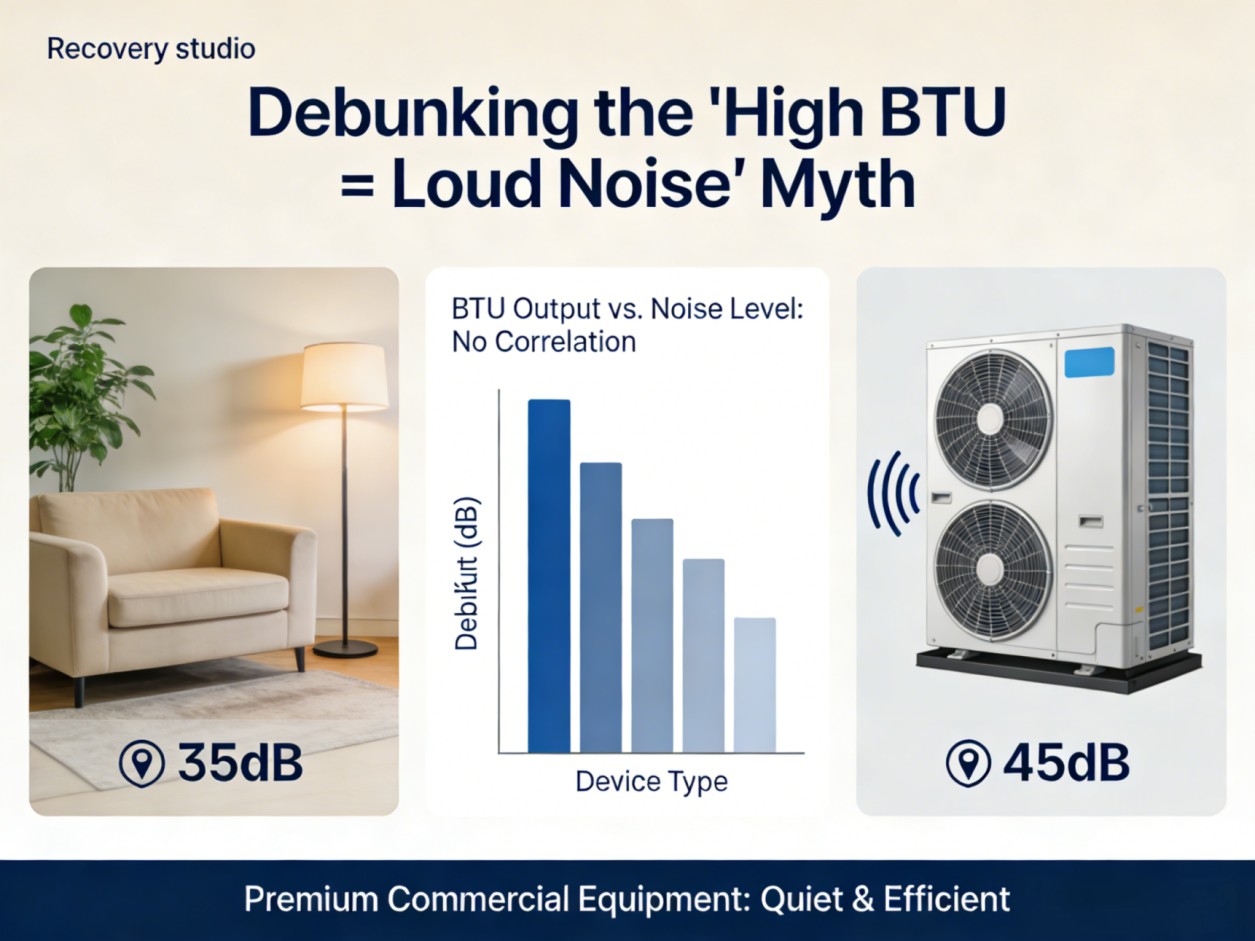
Residential chillers are increasingly engineered for silence, with high-end "Prosumer" models operating between 39 dB and 50 dB—comparable to the hum of a quiet refrigerator. This is achieved through sound-dampening insulation, slower fan speeds, and the use of rotary compressors which vibrate less.
However, a trap for many gym owners is the use of generic industrial chillers (often repurposed aquarium or hydroponic chillers) which are sold as "commercial capable" due to their high BTU ratings. These units are often designed for factory floors or outdoor fish ponds, not spas. They can produce noise levels ranging from 65 dB to 85 dB. To put this in context, 60 dB is normal conversation; 80 dB is a vacuum cleaner. In a tiled, echoing spa room, a 70+ dB chiller is deafening and destroys the relaxation experience.
Commercial-specific recovery chillers bridge this gap. They utilize larger components that can run at lower speeds to move the same amount of air/refrigerant, reducing the "whine" of high-RPM fans. Furthermore, many commercial installations utilize "split systems," where the noisy compressor and condenser are located outdoors or in a mechanical room (remote location), leaving only the silent circulation of water in the recovery space.
4.2 Vibration and Component Wear
Vibration is the enemy of mechanical longevity. In cheaper residential or DIY setups, the chiller is often placed directly on the floor next to the tub, connected by flexible hoses. Over time, vibration from the compressor loosens plumbing fittings, leading to refrigerant leaks and rattling noises.
Commercial installations typically mandate vibration isolation pads, secured piping, and rigid mounting frames. Furthermore, the "skeleton" of the unit differs. Residential units often use plastic casings and lighter frames to reduce shipping weight. Commercial units utilize steel or heavy-duty fiberglass frames designed to withstand the physical abuse of a gym environment—being bumped by gym bags, weights, or cleaning equipment.
4.3 Pump Technology: AC vs. BLDC
The water pump is the heart of the system, running continuously to ensure filtration. Residential systems often use standard AC (Alternating Current) pumps, similar to aquarium pumps. While cheap, they are energy-intensive and, critically, they transfer their motor heat directly into the water they are pumping. A large AC pump can add significant heat load to the water, forcing the chiller to work harder to counteract the pump's own waste heat.
Modern commercial and high-end units are shifting toward Brushless DC (BLDC) motors. BLDC pumps are more expensive but run significantly cooler and quieter. They also offer variable speed control, allowing the flow rate to be dialed in precisely to the chiller's requirements. With fewer wearing parts (no brushes), BLDC pumps have a significantly longer lifespan (often 20,000+ hours) compared to standard AC pumps found in budget residential tubs.
5. Safety: Electrical, Chemical, and Structural
Safety is the area where the divergence between residential and commercial systems carries the highest legal, ethical, and financial stakes. Operating a wet electrical appliance in a public facility falls under strict regulatory scrutiny.
5.1 Electrical Safety, UL Certification, and Insurance
Water and electricity are a lethal combination. A significant portion of the "homebrew" and budget residential market relies on non-standardized equipment, such as modified chest freezers (the "chest freezer cold plunge"). These setups pose severe electrocution risks if water breaches the unsealed electrical components or if the user touches a live component while submerged. Even purpose-built residential units may lack third-party safety certification.
For commercial businesses, the gold standard—and often the legal requirement—is certification by a Nationally Recognized Testing Laboratory (NRTL) such as UL (Underwriters Laboratories) or ETL (Intertek).
● The Insurance Risk: Commercial insurance policies frequently contain clauses requiring all electrical equipment to be UL/ETL listed. If a fire or injury occurs involving a non-certified residential unit in a gym, the insurance claim may be denied on the grounds of negligence or using unlisted equipment outside its intended classification.
● Code Compliance: The National Electrical Code (NEC) and local building codes often mandate specific safety features for commercial "hydrotherapy" tubs, such as hardwired connections (rather than plug-in), dedicated emergency shut-off switches within sight of the tub, and Equipotential Bonding grids to prevent stray voltage shocks. Residential plug-in units do not support these integration requirements.
5.2 Corrosion Resistance: The Material Science of Steel
The material composition of the tub and the chiller's heat exchanger dictates its resistance to corrosion, particularly when sanitizing chemicals or salt are used.
● 304 Stainless Steel: Commonly used in kitchen appliances and mid-range residential tubs. While resistant to rust in fresh water, it is vulnerable to "pitting" and crevice corrosion when exposed to chlorides (salts) or high levels of chlorine/bromine. In a commercial environment where chemical sanitizers are mandatory, a 304 steel tub will degrade.42
● 316 Stainless Steel (Marine Grade): Contains Molybdenum (2–3%), which drastically increases resistance to chlorides and acids. Commercial tubs and heat exchangers must be constructed from 316 steel or Titanium to withstand the chemical sanitation required by health codes. Using a 304 steel residential tub in a commercial gym with daily chlorination will lead to rust, leaks, and structural failure within months, potentially causing water damage to the facility.28
5.3 Warranty Voids and Liability
Manufacturers explicitly distinguish between use cases in their warranty terms. Almost all residential cold plunge warranties contain a "Commercial Use Exclusion" clause.
● Example Clause: "Warranty is void if the Product is installed in a commercial application".45
● Implication: A gym owner purchasing a residential unit to save money (e.g., investing $5,000 instead of $15,000) essentially self-insures the equipment. If the chiller burns out in 3 months due to the high duty cycle—a likely scenario—the replacement cost falls entirely on the business owner. Moreover, using equipment against manufacturer recommendations can be used as evidence of negligence in the event of a user injury lawsuit.2
6. Structural Differences: Insulation and Condensation
The physical construction of the tub impacts not just thermal retention but also the integrity of the surrounding facility infrastructure.
6.1 Insulation Physics and R-Value
Insulation efficiency is measured by R-value. Many residential portable tubs (inflatable or thin plastic) have low R-values. This allows rapid heat gain from the environment, forcing the chiller to run longer and harder.
Commercial tubs typically feature double-walled fiberglass or stainless steel construction with high-density polyurethane foam injection, achieving high R-values.21 This insulation is crucial not just for keeping the water cold, but for preventing the exterior of the tub from becoming a condensation surface.
6.2 The Condensation (Sweating) Problem
One of the most damaging hidden problems with home units in commercial spaces is condensation or "sweating." This occurs when the surface temperature of the tub or plumbing drops below the "dew point" of the surrounding air.
In a gym environment, humidity is often high due to sweating bodies, showers, and open doors. If the dew point is $65^circtext{F}$ and the chiller hoses or tub walls are $45^circtext{F}$, water will condense on the exterior surfaces continuously.
● Flooring Damage: This constant moisture can rot subfloors, warp wood/laminate, and destroy carpets.5
● Mold Growth: Constant dampness under and around the unit creates an ideal environment for mold and mildew, contributing to "Sick Building Syndrome" and potential health code violations.
● Vapor Barriers: Commercial installations utilize proper vapor barriers and closed-cell elastomeric insulation (e.g., Armaflex) on all piping to prevent moisture drive and condensation. Residential DIY setups often neglect this, resulting in wet floors that constitute a slip-and-fall hazard for gym members.50
7. Usage Comparison: Residential vs. Commercial
To summarize the operational differences, the following comparison matrix defines the capabilities and limitations of each system type, providing a clear guide for procurement.
7.1 Comparison Matrix: Technical Specifications
Feature | Residential System (Home Use) | Commercial System (Gym/Spa Use) |
Cooling Engine | 1/4 HP – 1/2 HP Reciprocating Compressor | 1 HP – 2 HP+ Rotary/Scroll Compressor |
Cooling Capacity | 2,000 – 4,000 BTU/hr | 9,000 – 24,000+ BTU/hr |
Target Throughput | 1–2 users per day | 4–10+ users per hour |
Recovery Time | Slow (45–60 mins per user load) | Rapid (5–10 mins or continuous) |
Filtration | Small Cartridge / Paper (10–20 sq. ft.) | Large Media / Spa Filter (50–100 sq. ft.) |
Sanitation | UV/Ozone (Basic); Manual dosing | Auto-dosing (Chlorine/Bromine), High-output Ozone/UV |
Duty Cycle | Intermittent (Cyclical) | Continuous (24/7 readiness) |
Material Construction | Plastic, Vinyl, 304 Stainless | Fiberglass, 316 Marine Stainless, Titanium |
Warranty Terms | 1 Year (Void in Commercial applications) | 1–3 Years (Commercial use expressly included) |
Safety Certification | CE (often), UL (rare) | UL / ETL Listed, NSF (optional) |
7.2 Use Case Definitions
The Home User (Residential)
● Profile: Individual bio-hackers, couples, or small families using the plunge for morning routines.
● Requirements: Silence, aesthetics, plug-and-play simplicity (110V standard plug), low energy consumption.
● Acceptable Limitation: The unit can take overnight to cool down initially. It does not need to recover temperature instantly after use because the next use is typically 24 hours away.
● Recommendation: A high-quality residential unit (1/2 HP) with basic filtration is sufficient and cost-effective.
The Commercial Operator (Gym/Recovery Studio)
● Profile: Businesses charging members for access (subscriptions or drop-in fees); high expectations for consistency, hygiene, and uptime.
● Requirements: Rapid recovery (high BTU), robust sanitation (health code compliance), durability (heavy frame), safety certification (insurance compliance).
● Critical Necessity: The unit must maintain $<50^circtext{F}$ ($<10^circtext{C}$) even with a new body entering every 15 minutes.
● Recommendation: Only true commercial systems (1 HP+, 316SS/Titanium, high-flow filtration) should be considered. Using residential gear here is a false economy that risks liability, increased labor costs, and reputational damage.2
8. Conclusion
The distinction between residential and commercial ice bath systems is not merely a marketing strategy; it is a fundamental divergence in engineering intent dictated by the laws of physics and microbiology. Residential systems are designed for the static maintenance of cold water for low-frequency use, prioritizing compactness and quiet operation. Commercial systems are designed for the dynamic rejection of heat under high-frequency loads, prioritizing recovery speed, hygiene, and structural durability.
For the home user, a commercial system may be overkill—too loud, too power-hungry, and unnecessarily expensive. However, for the commercial operator, a residential system is a liability. The inability to maintain therapeutic temperatures during peak hours compromises the service product. The inadequacy of low-flow filtration systems in handling high bather loads creates genuine health risks regarding bacterial infection. Furthermore, the reliance on non-certified, residential-grade electrical components in a wet, commercial environment invites uninsurable disaster.
As the industry matures, the "Prosumer" category is emerging, yet the thermodynamics remain absolute. No amount of branding can enable a 1/4 HP chiller to effectively cool a busy gym's plunge tub. Stakeholders must look past the aesthetic shell of the equipment and scrutinize the specifications—BTU ratings, filtration surface area, material composition, and certifications—to ensure their investment matches their operational reality. In the high-stakes environment of health and wellness, the cost of equipment failure is measured not just in replacement dollars, but in client trust and safety.
At Quanguan, we work directly with gyms,recovery studios, and professional facilitiesto ensure commercial ice bath systems areinstalled correctly from day one. With hands-on manufacturing experience and adeep understanding of real-worldinstallation challenges, our team helpsclients avoid common mistakes, reducelong-term operating costs, and achievestable, reliable performance.
lf you are planning a commercial ice bath installation or evaluating systemrequirements for your facility, contact Quanguan to discuss your project and getpractical guidance tailored to your spaceand usage needs.
References:
1. Cold Plunge Tanks: Considerations for Environmental public health, = https://ncceh.ca/sites/default/files/2024-04/NCCEH%20Cold%20plunge%20tanks%20-%20April%202024%20final%20EN.pdf
2. Is an ice bath a headache for business to own? - Brass Monkey, =, https://www.brassmonkey.co/blogs/journal/is-an-ice-bath-a-headache-for-business-to-own
3. Is Your Cold Plunge Water Safe?, =https://plungecrafters.com/blogs/diy-cold-plunge-chronicles/is-your-cold-plunge-water-safe
4. The 'Dangers' Of Home Made and Metal Ice Baths - iCoolsport, = https://icoolsport.com/blogs/recovery/dangers-of-ice-baths
5. Mold in The Gym: A Serious Threat to Your Health - FunGuy Inspections, =https://funguyinspections.com/mold-in-the-gym/
6. The Ultimate Guide To Ice Bath Tubs: DIY Vs. Professional Solutions - Alphasauna, = https://alphasauna.com/the-ultimate-guide-to-ice-bath-tubs-diy-vs-professional-solutions/
7. The Recovery Club Ice Bath Solution from Hell and How iCoolsport Provided Solutions, =https://icoolsport.com/blogs/recovery/the-recovery-club-ice-bath-solution-from-hell
8. Best Ice Bath & Cold Plunge Chillers: How to Choose Yours - Sun Home Saunas, =https://sunhomesaunas.com/blogs/saunas/buying-ice-and-cold-plunge-chillers
9. What Size Water Chiller for Ice Bath Do You Need? (Complete Guide), = https://coldtubchiller.com/what-size-water-chiller-for-ice-bath-do-you-need-complete-guide/
10. Predicting Temperature Changes During Cold Water Immersion and Exercise Scenarios: Application of a Tissue–Blood Interactive W - Bioheat Transfer Laboratory, =https://bioheat.umbc.edu/wp-content/uploads/sites/363/2015/07/Rupak_20151.pdf
11. What Size Chiller for Cold Plunge: A Complete Guide for Recovery Enthusiasts, =https://iceboundessentials.com/blogs/icebound-insights/what-size-chiller-for-cold-plunge
12. 1/4 HP vs. 1/2 HP vs. 1 HP Chillers: Complete Cold Plunge Chiller Sizing Guide, =https://peakprimalwellness.com/blogs/wellness/1-4-hp-vs-1-2-hp-vs-1-hp-chillers-sizing-guide
13. Choosing the Right Cold Plunge Chiller: What BTU, Amps, Watts, and HP Really Mean, https://regentotalwellness.com/blogs/regen/choosing-the-right-cold-plunge-chiller-what-btu-amps-watts-and-hp-really-mean
14. How to Choose the Perfect Cold Plunge Chiller: Technical Guide - Icebound Essentials, https://iceboundessentials.com/blogs/icebound-insights/choosing-cold-plunge-chiller-guide
15. Thermal Conditions Lecture - Cornell University Ergonomics Web, https://ergo.human.cornell.edu/studentdownloads/DEA3500notes/Thermal/thcondnotes.html
16. Ice Bath Chiller Common After-sales Problems And Solutions - Syochi, https://syochi.com/ice-bath-chiller-after-sales-problems-and-solutions/
17. Chiller Troubleshooting Guide: Common Problems & Solutions, https://waterchillers.com/blog/troubleshooting-common-chiller-problems-solutions/
18. QUICK CALCULATIONS - Heatcraft, https://www.heatcraftrpd.com/dA/8f0e828a41/CA-QC.pdf
19. What is the noise level of an industrial chiller? - Blog - Rhong Machinery Factory, https://www.rhongmachines.com/blog/what-is-the-noise-level-of-an-industrial-chiller-432786.html
20. Cold plunge tanks: Considerations for environmental public health, 访问时间为 一月 20, 2026, https://ncceh.ca/resources/evidence-briefs/cold-plunge-tanks-considerations-environmental-public-health
21. What is the difference between a residential cold plunge & a commercial cold plunge? : r/coldplunge - Reddit, https://www.reddit.com/r/coldplunge/comments/1mxmpud/what_is_the_difference_between_a_residential_cold/
22. Common Chiller Failures and Solutions - coldchiller, https://coldchiller.com/common-chiller-failures-and-solutions/
23. Common Faults in Cold Plunge Chillers: Understanding Issues and Solutions,https://coldchiller.com/common-faults-in-cold-plunge-chillers/
24. How Often Should You Change Your Cold Plunge Water? - Sun Home Saunas, https://sunhomesaunas.com/blogs/cold-plunges/change-your-cold-plunge-water
25. Is there any health concern from not cleaning ice bath? : r/coldplunge Reddit,https://www.reddit.com/r/coldplunge/comments/1htdr9c/is_there_any_health_concern_from_not_cleaning_ice/
26. What is Cold Plunge Maintenance and Why Does It Matter? - Sun Home Saunas, https://sunhomesaunas.com/blogs/cold-plunges/cold-plunge-maintenance
27. Keeping Your Cold Plunge Water Clean: The Ultimate Guide - Icebound Essentials, https://iceboundessentials.com/blogs/icebound-insights/cold-plunge-water-maintenance
28. Is there a steel that can withstand constant contact with a saturated saltsolution?Reddit,https://www.reddit.com/r/materials/comments/17jne3q/is_there_a_steel_that_can_withstand_constant/
29. How loud are the water chillers? - The Pod Company Help Center, https://podcompany.gorgias.help/en-US/how-loud-are-the-water-chillers-306717
30. Is the Recovery Chiller for Ice Bath Noisy? - coldchiller, https://coldchiller.com/is-the-recovery-chiller-for-ice-bath-noisy/
31. Comparing the Noise Levels of Air-Cooled Chillers to Water-Cooled Chillers - AMCON, https://amcon.com.my/comparing-the-noise-levels-of-air-cooled-chillers-to-water-cooled-chillers/
32. Ice Bath Chiller Noise Levels: What's Acceptable & Why It Matters - Syochi, https://syochi.com/ice-bath-chiller-noise-levels-whats-acceptable-why-it-matters/
33. What is the noise level of a water chiller? - Blog, https://www.hzairdryer.com/blog/what-is-the-noise-level-of-a-water-chiller-1451820.html
34. good practices on ventilation system noise control - Environmental ProtectionDepartment,https://www.epd.gov.hk/epd/english/environmentinhk/noise/help_corner/files/Vent_sys_E-06.pdf
35. Cold Plunge Pump Guide: Avoid Cost, Noise & Cooling Mistakes | BLDC Pump, https://dcwaterpump.com/cold-plunge-pump-guide-avoid-mistakes/
36. DIY Chest Freezer Ice Bath - Is It Worth The Risk?, https://www.myritual.com.au/journal/chest-freezer-ice-bath-dangers
37. What Gym Insurance Does My Fitness Facility Really Need? | NYC Business Group,https://www.nycbusinessgroup.com/insurance/blog-post/what-gym-insurance-does-my-fitness-facility-really-need/
38. 9 Reasons A Commercial Insurance Claim Could Be Denied | NEXT, https://www.nextinsurance.com/blog/commercial-insurance-claim-denial/
39. The 5 Electrical Requirements for Cold Plunge Installation - Sun Home Saunas, https://sunhomesaunas.com/blogs/saunas/understanding-electrical-requirements-for-cold-plunge-installation
40. Electrical and Plumbing Requirements for Cold Plunge Tubs - Haven Of Heat, https://havenofheat.com/blogs/ice-bath-guides/electrical-requirements-cold-plunge-tubs
41. LISTING AND LABELING OF ELECTRICAL EQUIPMENT IN THE STATE OF MINNESOTA - StPaul.gov, https://www.stpaul.gov/sites/default/files/2023-06/DSI.Bldg_Electrical_Listing-Labeling%20Equipment.pdf
43. Manufacturing Insights: 304 Vs 316 Stainless Steel - Ruvati, https://www.ruvati.com/t-304-vs-t-316-grade-stainless-steel/
44. Stainless Steel Grades Explained - 304 vs 316 | Danver, https://danver.com/blog/304-316-stainless-steel-grades/
45. KOHLER® x Remedy Place Ice Bath Two-Year Limited Warranty, https://www.kohler.com/content/dam/kohler-com-NA/Lifestyle/PDF/pdf-1610180-12-kohler-remedy-place-ice-bath-two-year-limited-warranty.pdf
46. Cold Tub Warranty | ReGen Total Wellness, https://regentotalwellness.com/pages/warranty-policy
47. Freeze to Death Cold Plunge Tub Residential 1-Year Limited Warranty, https://help.plunge.com/hc/en-us/articles/30632182392340-Freeze-to-Death-Cold-Plunge-Tub-Residential-1-Year-Limited-Warranty
48. Warranty & Liability - The Pod Company, https://podcompany.com/pages/warranty
49. Why Does Your Floor Sweat and How to Stop It - Armorpoxy Inc, https://armorpoxy.com/why-does-you-floor-sweat-and-how-to-stop-it
50. Insulating Chilled Water Systems | Johns Manville, https://www.jm.com/en/blog/2022/august/insulating-chilled-water-systems/
51. How to prevent condensation? : r/coldplunge - Reddit, https://www.reddit.com/r/coldplunge/comments/1ly2bec/how_to_prevent_condensation/
52. Outdoor Humidity and Condensation : r/coldplunge - Reddit, https://www.reddit.com/r/coldplunge/comments/1b71c9v/outdoor_humidity_and_condensation/
53. The Recovery Gap: Why Most Gyms Fail at Ice Bath Recovery - Brass Monkey, https://www.brassmonkey.co/blogs/journal/the-recovery-gap-why-most-gyms-fail-at-ice-bath-recovery